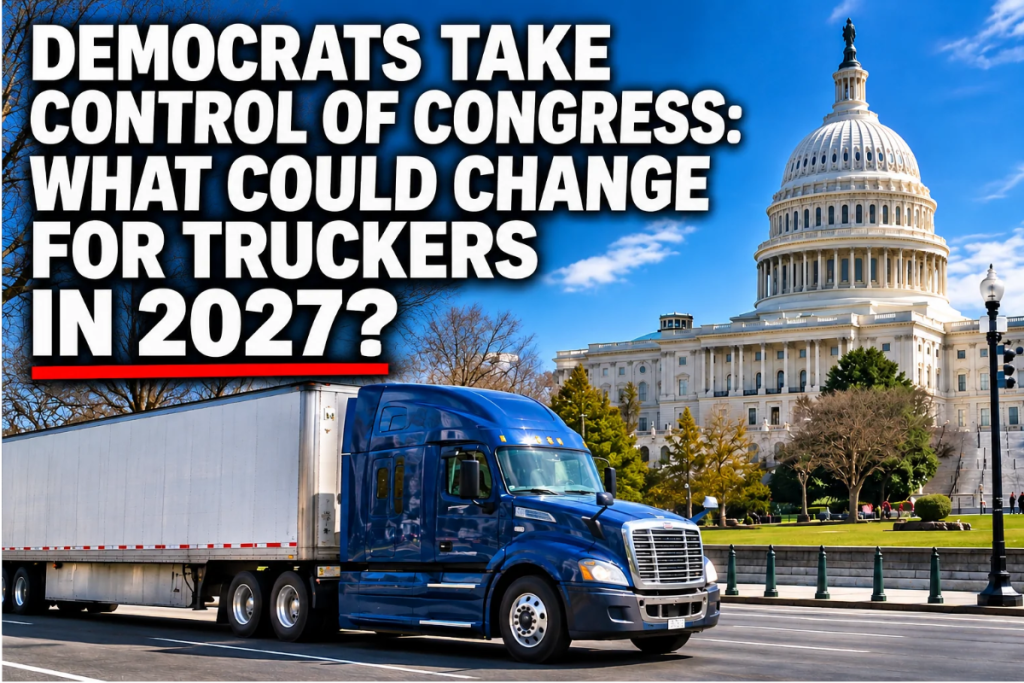
Big changes are coming to Washington following the 2026 midterm elections, and the trucking industry could be facing some changes of its own. According to the Associated Press, Democrats won control of both the House and Senate in the November 3 elections, setting the stage for new debates over trucking regulations, highway funding, insurance requirements, and federal safety enforcement. With Republican President Trump still in the White House, the next two years could bring some disagreements over how the trucking industry should be regulated.
As Transport Topics reported, the election results will bring new leadership to congressional committees responsible for transportation policy. Democrats will have greater influence over legislation affecting the Federal Motor Carrier Safety Administration (FMCSA), along with the ability to conduct oversight hearings and question federal regulators. However, any major legislation will still need to make it through Congress and receive the president’s signature, unless lawmakers can gather enough support to override a veto.

Trucking Insurance Requirements Could Be Back on the Table
One issue that could resurface is the federal minimum liability insurance requirement for motor carriers. Currently, most interstate for-hire carriers transporting nonhazardous property must carry at least $750,000 in liability coverage.
According to a recent article by Commercial Carrier Journal, some Democratic lawmakers have previously supported raising that minimum to as much as $5 million. Supporters of increasing the requirement argue that the current minimum has not kept pace with medical expenses and the costs associated with serious crashes.
For owner-operators and small trucking companies, a significant increase could mean higher operating expenses. Opponents of the proposal worry that higher insurance requirements could make it harder for smaller carriers to stay in business. While no increase has been enacted as a result of the election, the issue could receive renewed attention as lawmakers begin discussing transportation legislation in 2027.
FMCSA Rules Could Face More Congressional Scrutiny
Another area to watch is the FMCSA, particularly its recent enforcement priorities involving driver qualifications, English language proficiency, and non-domiciled commercial driver’s licenses.
In a November 4 report, transportation attorney Brandon Wiseman explained that Democratic control of Congress could lead to increased oversight of FMCSA policies. Congressional committees may hold hearings, request agency records, and examine how federal regulations are being enforced.
Commercial Carrier Journal also reports that lawmakers could take a closer look at roadside English language proficiency evaluations and restrictions affecting certain non-domiciled CDL holders. These issues have already generated disagreements over highway safety, enforcement consistency, and driver eligibility.
However, that does not mean existing regulations will automatically disappear. The FMCSA remains responsible for administering federal motor carrier safety rules, and changes generally require formal agency action, legislation, or court decisions. For now, truckers and carriers should continue following the requirements currently in effect.
Truck Parking, Safety Technology, and Highway Funding
Congress will also need to address the next major federal highway funding package, which could have a direct impact on the trucking industry.
According to Commercial Carrier Journal, the BUILD America 250 Act advanced through a House committee earlier in 2026 with several trucking-related provisions. The proposal included $750 million for truck parking grants, along with measures addressing fraudulent lease-purchase agreements, electronic logging device certification, and freight broker fraud.
A separate FreightWaves report explains that changes in congressional leadership could affect which provisions make it into the next transportation bill. Truck parking funding may remain a priority, while lawmakers could also revisit proposals involving autonomous trucks and federal safety requirements.
Other possible discussions include speed limiters, automatic emergency braking, and trailer underride protections. However, these are potential legislative priorities, and there is no guarantee that any particular proposal will become law.

So What Does This Mean for Owner-Operators?
For truckers, the biggest thing to understand is that the election results do not immediately change federal trucking regulations. Insurance minimums, hours-of-service requirements, driver qualification standards, and other existing rules remain in place unless they are formally changed.
In a November 4 commentary published by Transport Topics, the American Trucking Associations emphasized that many of the industry’s biggest concerns remain the same regardless of which political party controls Congress. Those include cargo theft, deteriorating infrastructure, truck parking shortages, safety compliance, and lawsuit-related costs.
The coming months should give truckers a clearer picture of what the new Congress plans to prioritize. Whether those discussions lead to higher operating costs, additional truck parking, new safety requirements, or continued political disagreements remains to be seen.