After years of delays, test programs, and plenty of questions from the trucking industry, the Tesla Semi may finally be entering its biggest phase yet.
Tesla is holding a major Semi Rollout event on September 24 at its dedicated factory in Sparks, Nevada, and several familiar names in trucking and freight appear to be part of the celebration. The event comes as Tesla ramps production of its Class 8 electric truck and lands new orders from fleets across the country.
For truckers, the timing is especially interesting. Diesel prices have climbed dramatically in 2026, giving fleets another reason to take a closer look at whether battery-electric trucks can actually compete with diesel when it comes to operating costs.
A Parking Lot Full of Tesla Semis
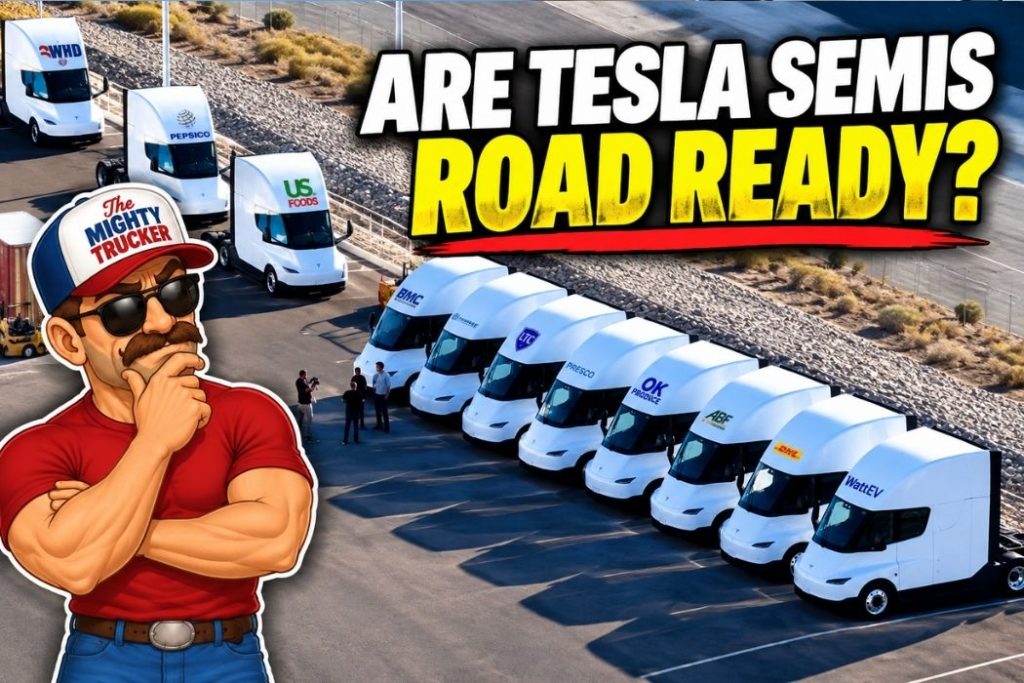
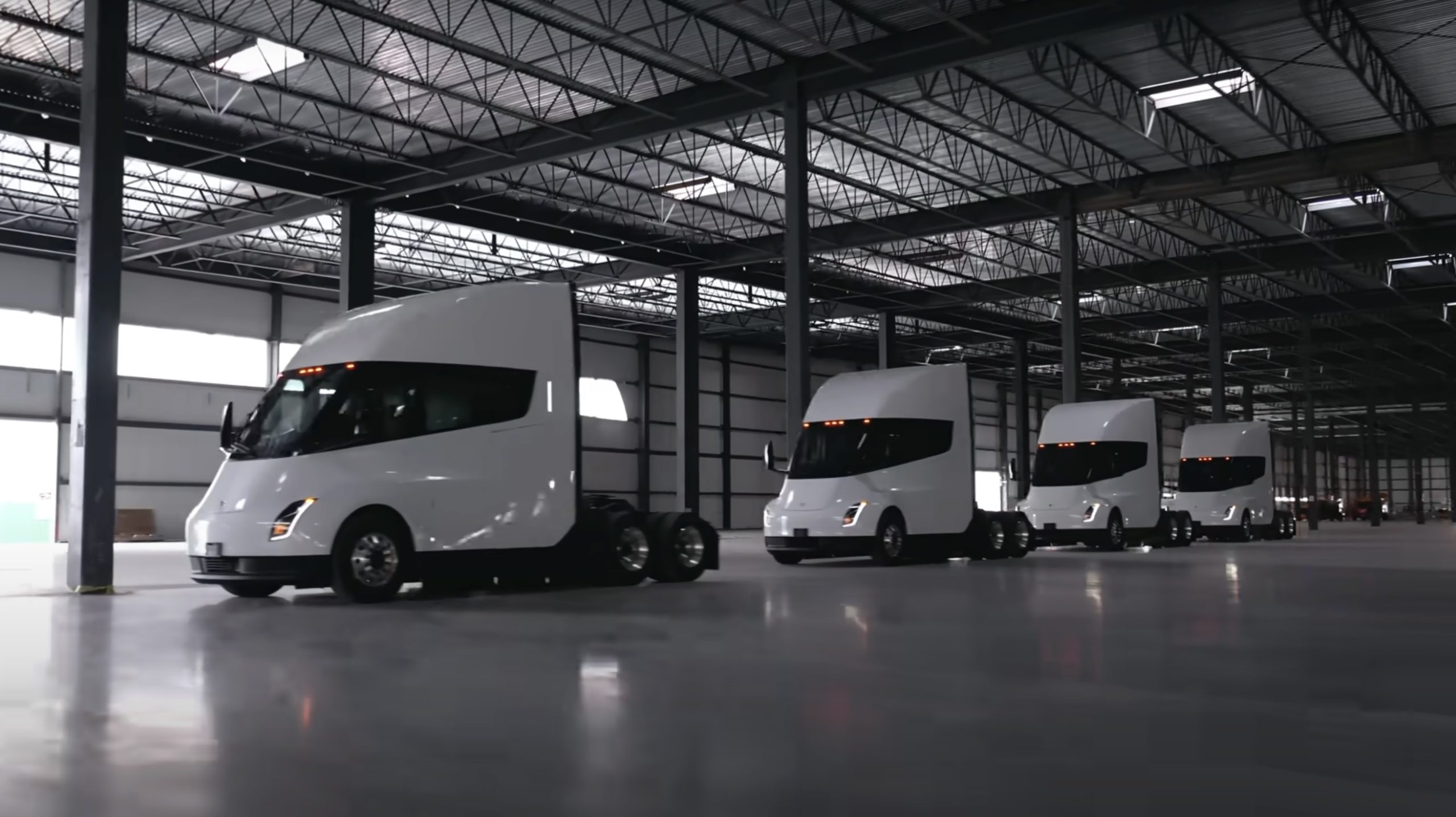
According to Electrek, drone footage taken outside Tesla’s new Semi factory showed at least 11 trucks staged around the facility ahead of the event.

Several of the trucks were already wearing fleet branding. Companies visible in the footage included PepsiCo, DHL, US Foods, ABF Freight, Einride, IMC Logistics, OK Produce and WattEV, among others. Some are already known Tesla Semi customers, while others could represent new fleet announcements.
PepsiCo has been involved with the Semi longer than almost anyone. The company received Tesla’s first customer trucks in 2022 and has since accumulated real-world experience running them in freight operations. But the appearance of so many different fleet names outside the factory suggests Tesla is now trying to move beyond small-scale demonstrations and put the Semi into the hands of a much wider group of trucking companies.
Tesla’s New Semi Factory Is Finally Running
Tesla first unveiled the Semi all the way back in 2017, originally targeting production in 2019. That deadline came and went, followed by several more delays.
Things finally started moving in a bigger way this year. The first Semi rolled off Tesla’s new high-volume production line in Nevada in April. The dedicated factory covers approximately 1.7 million square feet and is designed to eventually produce as many as 50,000 trucks per year, although that figure represents the plant’s planned capacity rather than its current production rate.
Tesla says the Semi is available in two configurations: a 325-mile Standard Range model and a 500-mile Long Range model. Both use an 800-kW three-motor powertrain. The trucks also use Tesla’s Megacharger system. Tesla says it can restore roughly 70% of the truck’s range in about 30 minutes under appropriate charging conditions
Some Big Orders Are Starting to Arrive
The trucks lined up outside the factory aren’t the only indication that Tesla is gaining interest from fleets. In August 2026, electric trucking company Einride announced plans to add 500 Tesla Semis to its fleet over the following two years. Soon after, Tesla was selected as the primary manufacturer for a 2,500-truck battery-electric Class 8 purchase organized through ZET SCALE, an alliance whose founding shippers include Microsoft and PepsiCo. (However, it is worth noting that Tesla isn’t necessarily supplying all 2,500 trucks. Kenworth, Volvo and RIDE were also selected as secondary manufacturers, and organizers have not disclosed exactly how many of the 2,500 will be Tesla Semis.)
Still, organizers describe it as the largest electric Class 8 truck order in the U.S. to date. The trucks are expected to be deployed across major freight hubs including Los Angeles, Seattle-Tacoma, Houston, Dallas, Chicago, Atlanta and the New York-Newark area.
High Diesel Prices Could Make Things Interesting
One of the biggest questions surrounding electric semis has always been economics. Battery-electric Class 8 trucks can carry a substantially higher upfront price than comparable diesel tractors, meaning fleets have to look beyond the sticker price and calculate electricity, maintenance, charging infrastructure, payload, utilization and resale value.
Investor’s Business Daily reports Tesla’s 500-mile Long Range Semi has recently been quoted around $290,000, while the 325-mile Standard Range model is around $260,000 based on California incentive data. Those prices may be intimidating, but diesel has also become dramatically more expensive lately.
We recently posted an article that said the national average for diesel reached $5.85 per gallon in early September, a record at the time. For a fleet burning thousands or millions of gallons per year, a prolonged increase in diesel prices could significantly change the math when comparing diesel and electric trucks.
Tesla Semi program director Dan Priestley has argued that the Semi is designed to deliver a lower operating cost per mile than diesel. Whether those savings materialize across different types of real-world trucking operations will be one of the biggest things for the industry to watch as more Semis enter service.
But Electric Trucks Still Have Challenges
Affording the truck is only part of the equation. Fleets also need enough charging capacity to keep trucks moving without disrupting schedules. Routes have to work within the truck’s range, charging has to fit into normal operations, and drivers and technicians need training for the equipment.
Those challenges can look very different for a truck returning to the same terminal every night than for an owner-operator hauling unpredictable loads across the country.
Rudy Diaz, CEO of Hight Logistics, told FreightWaves that successful electric-truck deployments require not only capable trucks, but dependable charging infrastructure, route planning and properly trained drivers and technicians.
That’s an important distinction for truckers. A 500-mile advertised range doesn’t automatically make an electric truck a direct replacement for every diesel tractor on the road.
Tesla Semi Is Entering Its Biggest Test Yet
For years, the Tesla Semi has existed somewhere between a promising new Class 8 truck and a long-delayed experiment. Now could be its chance to prove its worth.
Tesla now has a dedicated factory, production trucks coming off the line, major fleets placing orders and more customer-branded Semis preparing to hit the road.
But the real test won’t happen on a stage in Nevada. It’ll happen when thousands of these trucks are hauling freight every day — through summer heat, winter weather, steep grades, tight delivery schedules and all the other realities professional drivers deal with.
If Tesla can ramp production anywhere close to its ambitions, truckers are going to start seeing a lot more Tesla Semis on America’s highways.
Read more on The Mighty Trucker: